CXL Memory Expansion Market Summary
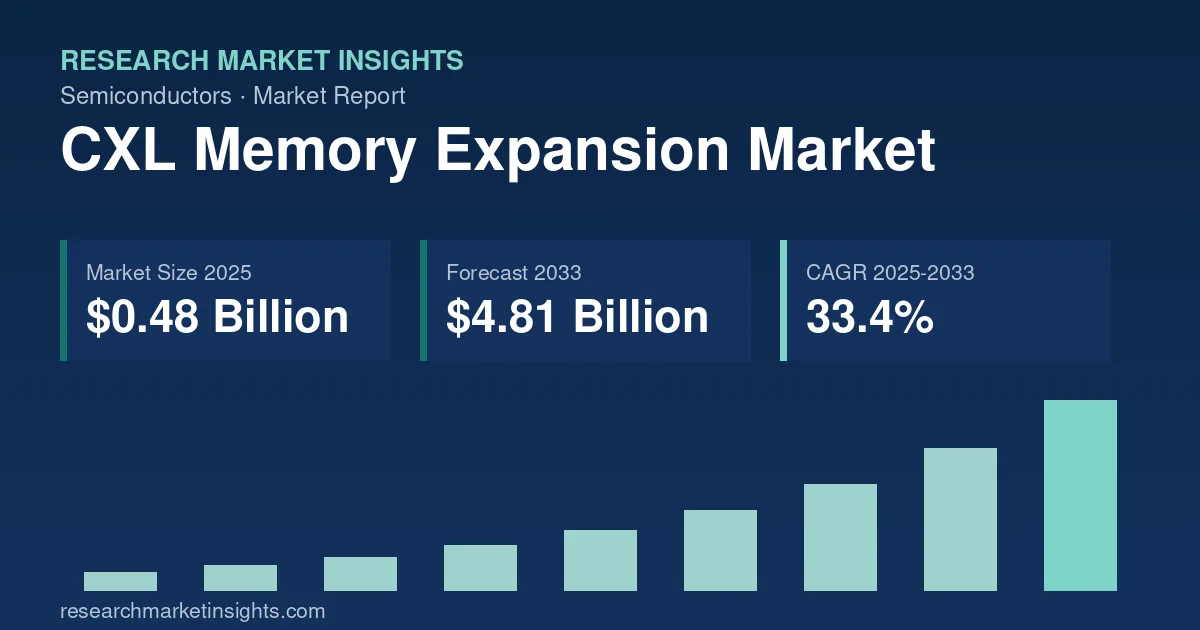
The global CXL memory expansion market was worth an estimated USD 0.48 billion in 2025 and is projected to reach USD 4.81 billion by 2033, growing at a CAGR of 33.4%.
Key Report Takeaways
- Memory expander modules generated about 76% of 2025 revenue; switches and pooling hardware are the fastest-growing component.
- North America accounted for about 58% of 2025 demand, led by hyperscale cloud providers.
- CXL 3.x memory pooling moves from sampling to production from late 2026, shifting demand from direct-attached expansion to shared memory.
- Record DRAM contract prices in 2026 raise the value of every CXL module and strengthen the business case for memory tiering.
Forecast Scenarios to 2033
CXL Memory Expansion Market Size and Forecast
How We Estimated the CXL Memory Expansion Market
Our numbers are not a black box. This is the bottom-up model behind the market size, step by step, so you can check every assumption before you buy.
| Step | Value | Basis |
|---|---|---|
| 2025 Base Year | ||
| Servers shipped worldwide | 14.0 million | Server shipment trackers; total 2026 growth of about 13% reported by TrendForce |
| CXL-capable platform share | 38% | Share of shipments on CXL 2.0 platforms such as Intel Xeon 6 |
| Servers able to use CXL memory | 5.32 million | 14.0 million × 38% |
| Attach rate (servers fitted with CXL memory) | 3.2% | Hyperscale pilots and early production; enterprise adoption near zero |
| Servers with CXL memory | 170,000 | 5.32 million × 3.2% |
| Average CXL capacity per server | 384 GB | For example three 128 GB E3.S expander modules |
| CXL-attached DRAM shipped | 65 PB | 170,000 × 384 GB |
| Blended module price per GB | USD 5.60 | DDR5 contract pricing plus controller and module premium |
| Expander module revenue | USD 0.37 billion | 65 PB × USD 5.60 per GB |
| Controllers, switches, pooling hardware and software | USD 0.11 billion | About 24% of the total, from supplier disclosures and pricing checks |
| 2025 market size | USD 0.48 billion | Module revenue plus other components |
| 2033 End of Forecast | ||
| Servers shipped worldwide | 22 million | About 6% average annual growth |
| CXL-capable platform share | 90% | CXL standard on mainstream server CPUs |
| Attach rate | 9% | Tiering and pooling reach mainstream AI and database servers |
| Average CXL capacity per server | 1,024 GB | 256–512 GB modules and pooled capacity |
| Blended module price per GB | USD 2.20 | Long-run DRAM price normalization |
| 2033 market size | USD 4.81 billion | 1.82 EB × USD 2.20 per GB = USD 4.01 billion in modules, plus USD 0.80 billion in other components |
Medium Confidence Emerging market; estimate triangulated from shipments, pricing and supplier disclosures.
Report Overview
Market Overview
Compute Express Link (CXL) lets a server attach extra DRAM over a PCIe-based link instead of only through the DIMM slots on the motherboard. A CXL memory expander (a CXL “Type 3” device) is the most common form: an E3.S module or add-in card that carries DRAM and a CXL controller. The CPU sees that memory as an additional tier, so a server can add capacity and bandwidth without adding sockets.
The market is young. In 2025 most CXL memory still shipped into hyperscale pilots and early production fleets, and nearly all of it used CXL 2.0 devices. We estimate the market at USD 0.48 billion in 2025, with expander modules accounting for about three quarters of revenue. Our model, set out step by step in the “How We Estimated” section, assumes about 170,000 servers were fitted with CXL memory in 2025, averaging 384 GB each.
Why CXL Memory Expansion Matters Now
Three forces are converging:
- The memory wall: processor core counts have grown faster than memory channels, so memory per core is now the bottleneck for AI inference, in-memory databases and analytics.
- Native platform support: Intel’s Xeon 6 processors support CXL 2.0 Type 1, 2 and 3 devices, with a hardware-managed Flat Memory Mode that presents DRAM and CXL memory as one pool.
- Expensive DRAM: conventional DRAM contract prices roughly doubled quarter over quarter in early 2026, making better memory utilization a board-level priority.
Technology Landscape
- CXL 1.1 and 2.0: direct-attached expansion, one host per device. This is where almost all 2025 revenue sits.
- CXL 3.x: switching and fabrics that let several hosts share a memory pool. Switch silicon moved to sampling in 2026, and memory vendors have aligned next-generation modules with the CXL 3.2 specification.
- Form factors: E3.S modules dominate in servers with EDSFF bays; add-in cards suit retrofit and lab deployments; pooled appliances package many terabytes behind a switch.
Segment Analysis
By Component (2025 Revenue Share)
- Memory expander modules: about 76%. The DRAM inside each module carries most of the value.
- Expander controllers: about 11%. Merchant CXL controller silicon sold to module makers and OEMs.
- CXL switches and pooling appliances: about 9%. The fastest-growing component as CXL 3.x reaches production.
- Software and services: about 4%. Memory tiering, fabric management and integration.
By Application
- AI inference and training: the leading growth driver, as large-context models and key-value caches need more memory per host than DIMM slots provide.
- In-memory databases and analytics: the first production use case and still a large share of demand.
- HPC and cloud virtualization: adopt CXL to raise memory per core and consolidate virtual machines.
Regional Analysis
- North America: about 58% of 2025 demand. The largest region, reflecting the concentration of hyperscale cloud capacity.
- Asia Pacific: about 27%. The fastest-growing region, supported by cloud build-outs in China, Japan and India and by the memory and controller supply base in South Korea, Taiwan and China.
- Europe: about 11%. Driven by sovereign cloud and HPC programs.
- Latin America and Middle East & Africa: about 4% combined. Early adoption through new cloud regions and AI data center projects.
Competitive Landscape
The market is highly concentrated across three tiers:
- Memory module makers: Samsung Electronics, SK hynix and Micron Technology supply nearly all CXL memory modules.
- Controller vendors: Astera Labs, Montage Technology, Microchip Technology and Marvell Technology supply the CXL silicon.
- Switch and pooling vendors: a third tier that grows in importance as CXL 3.x memory pooling reaches production.
- Route to market: early volumes flow mainly through direct supply agreements with large cloud providers.
Outlook to 2033
We expect the market to reach USD 4.81 billion by 2033, a CAGR of 33.4% from 2025.
- Platforms: about 90% of new servers CXL-capable by 2033.
- Adoption: about 9% of servers shipping with CXL memory, averaging roughly 1 TB each.
- Pricing: DRAM prices per GB normalize from 2026 peaks.
- Growth engine: memory pooling becomes standard in AI clusters as CXL 3.x reaches production.
CXL Memory Expansion Market Dynamics
Key Market Trends
Large-context inference and key-value cache offload push memory per server beyond what DIMM slots can hold.
CXL 3.x switches enable rack-level memory pools that reduce stranded memory.
Conventional DRAM contract prices roughly doubled in 1Q26, turning memory utilization into a cost priority.
Early CXL module volumes flow through direct supply agreements with large cloud providers.
Drivers Impact Analysis
| Driver | Details | Impact |
|---|---|---|
| Memory wall in AI and analytics | Core counts grow faster than memory channels, so CXL adds capacity and bandwidth per socket. | High |
| Native platform support | Intel Xeon 6 supports CXL 2.0 Type 1, 2 and 3 devices, including hardware-managed Flat Memory Mode. | High |
| Cost of stranded memory | Pooling lets operators provision less DRAM per server and share the rest across hosts. | Medium |
Opportunities Impact Analysis
| Opportunity | Details | Impact |
|---|---|---|
| Rack-scale memory pools for AI clusters | CXL switches built for rack-level pooling open a new hardware category. | High |
| Software-defined memory tiering | Operating system and hypervisor tools that make CXL memory transparent to applications. | Medium |
CXL Memory Expansion Market Segmentation
By Component
- Memory Expander Modules
- Expander Controllers
- CXL Switches & Pooling Appliances
- Software & Services
By Form Factor
- E3.S Modules
- Add-in Cards (AIC)
- Other Form Factors
By CXL Generation
- CXL 1.1 & 2.0
- CXL 3.x
By Deployment Model
- Direct-Attached Expansion
- Pooled & Shared Memory
By Application
- AI Inference & Training
- In-Memory Databases & Analytics
- HPC & Simulation
- Cloud Virtualization
By End User
- Hyperscale Cloud Providers
- Tier-2 & Sovereign Cloud
- Enterprise Data Centers
- Research & HPC Centers
By Region
- North America: U.S., Canada, Mexico
- Europe: Germany, U.K., France, Italy, Spain, Rest of Europe
- Asia Pacific: China, Japan, India, South Korea, Australia, Rest of Asia Pacific
- Latin America: Brazil, Argentina, Rest of Latin America
- Middle East & Africa: Saudi Arabia, UAE, South Africa, Rest of Middle East & Africa
CXL Memory Expansion Market Regional Analysis
North America held the largest share in 2025. Asia Pacific is expected to grow fastest through 2033.
CXL Memory Expansion Market Competitive Landscape
Market Concentration
Key Companies Profiled
- Samsung Electronics
- SK hynix
- Micron Technology
- Astera Labs
- Montage Technology
- Microchip Technology
- Marvell Technology
- SMART Modular Technologies
- Rambus
- Panmnesia
- UnifabriX
- Liqid
Recent Developments
- March 2026Marvell announced the Structera S 30260, a 260-lane CXL switch for rack-level memory pooling, with customer sampling expected in calendar Q3 2026.
- 1Q 2026Conventional DRAM contract prices rose by roughly 93–98% quarter over quarter, according to TrendForce, with a further 58–63% rise expected in 2Q26.
- December 2025Korean press reported that Samsung moved its next-generation CMM-D memory module to the CXL 3.2 specification, targeting mass production by the end of 2026.
- 2025Astera Labs guided a production ramp of its Leo CXL memory controllers in the second half of 2025.
- September 2024Intel launched Xeon 6 processors with CXL 2.0 support for Type 1, 2 and 3 devices and Flat Memory Mode.
Is This Report Right for You?
Who This Report Is For
- Memory, controller and module vendors sizing their addressable market
- Server OEMs and ODMs planning CXL-ready platforms
- Cloud and data center infrastructure teams building a memory tiering business case
- Investors and analysts covering data center semiconductors
Decisions It Supports
- Prioritize CXL product investment by component, form factor and CXL generation
- Plan capacity and pricing for CXL modules and controllers through 2033
- Build the total-cost-of-ownership case for memory tiering and pooling versus adding DIMMs
- Identify partners and competitors across modules, controllers and switches
What's Inside
- 12Companies Profiled
- 7Segmentation Views
- PDF + ExcelFormats
Report Scope
| Market Size Value in 2025 | $0.48 Billion |
|---|---|
| Revenue Forecast in 2033 | $4.81 Billion |
| Growth Rate | CAGR of 33.4% from 2025 to 2033 |
| Base Year for Estimation | 2025 |
| Historical Data | 2022–2024 |
| Forecast Period | 2026–2033 |
| Quantitative Units | Revenue in USD Billion and CAGR from 2025 to 2033 |
| Report Coverage | Market size and forecast, market dynamics, segmentation, regional analysis, competitive landscape, company profiles |
| Segments Covered | Component, Form Factor, CXL Generation, Deployment Model, Application, End User |
| Regional Scope | North America; Europe; Asia Pacific; Latin America; Middle East & Africa |
| Key Companies Profiled | Samsung Electronics; SK hynix; Micron Technology; Astera Labs; Montage Technology; Microchip Technology; Marvell Technology; SMART Modular Technologies; Rambus; Panmnesia; UnifabriX; Liqid |
| Customization Scope | Country, regional and segment scope can be customized on request. |
Research Methodology
- Secondary Research Filings, trade data, patents, publications
- Primary Interviews Suppliers, manufacturers, buyers, experts
- Market Modeling Bottom-up and top-down estimates
- Triangulation & Review Cross-validated, analyst-reviewed
Frequently Asked Questions
What is the CXL Memory Expansion Market?
CXL memory expansion uses the Compute Express Link (CXL) standard to attach additional DRAM to servers over PCIe-based links, through expander modules, add-in cards or pooled memory appliances, so a server can add memory capacity and bandwidth beyond its DIMM slots.
How big is the CXL Memory Expansion Market?
The CXL Memory Expansion Market was valued at $0.48 Billion in 2025 and is projected to reach $4.81 Billion by 2033.
What is the growth rate of the CXL Memory Expansion Market?
The CXL Memory Expansion Market is expected to grow at a CAGR of 33.4% from 2025 to 2033.
Which region holds the largest share of the CXL Memory Expansion Market?
North America held the largest share of the CXL Memory Expansion Market in 2025.
Which region is growing fastest in the CXL Memory Expansion Market?
Asia Pacific is expected to register the fastest growth during the forecast period.
Who are the key companies in the CXL Memory Expansion Market?
Key companies profiled include Samsung Electronics, SK hynix, Micron Technology, Astera Labs, Montage Technology, Microchip Technology, Marvell Technology, SMART Modular Technologies.
Table of Contents
Chapter 1. Executive Summary
- Key Findings and Quick Answer
- Market Snapshot, 2025 and 2033
Chapter 2. Research Scope and Methodology
- Market Definition and Inclusions
- Bottom-Up Estimate Model
- Data Sources and Validation
Chapter 3. Market Dynamics
- Growth Drivers and Opportunities
- DRAM Pricing and Supply Outlook
- CXL Specification Roadmap (1.1, 2.0, 3.x)
Chapter 4. Market Size and Forecast, 2020–2033
- Market Size by Year, 2020–2033
Chapter 5. Market by Component
- Memory Expander Modules
- Expander Controllers
- CXL Switches and Pooling Appliances
- Software and Services
Chapter 6. Market by Form Factor
Chapter 7. Market by CXL Generation
Chapter 8. Market by Deployment Model
Chapter 9. Market by Application
Chapter 10. Market by End User
Chapter 11. Regional Analysis
- North America
- Europe
- Asia Pacific
- Latin America
- Middle East & Africa
Chapter 12. Competitive Landscape
- Market Concentration
- Company Profiles
Chapter 13. Analyst Recommendations
Request a Free Sample
Get the table of contents, methodology and selected data from this report by email within one business day.